
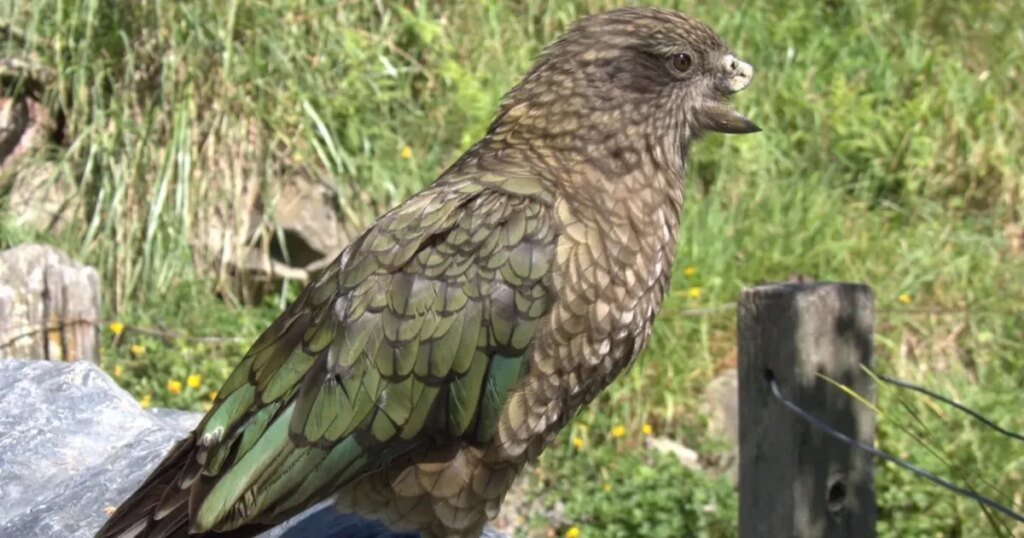
Parrot with Half a Beak Emerges as Alpha Male of His Flock
Bruce, the kea parrot, has lost his entire upper beak. According to the norms of animal hierarchy, he should rank low on the social ladder. Yet, he reigns as the undisputed leader of his group, having developed a unique fighting technique unseen in other parrots.
A study released on April 20, in Current Biology, explores how Bruce, an endangered kea parrot, has achieved and maintained his dominant status within his captive social group at Willowbank Wildlife Reserve in New Zealand. This represents the first documented case of a physically disabled animal reaching alpha status solely through behavioral innovation.
Bruce the Kea Parrot: An Unexpected Champion
Kea parrots are notorious for their mischievous behavior. “They often earn the title of hooligans, and justly so,” says study coauthor Ximena Nelson, a professor of animal behavior at the University of Canterbury. These birds are known for making snowballs, sledding on their backs, joyfully vandalizing tourists’ vehicles, and using their beaks to hurl rocks at passersby.
Bruce is no exception. Lacking a full beak, he cannot bite like his peers, so he devised a superior approach — a “jousting” method that catches his opponents off guard.
“Bruce uses his exposed lower beak to execute jousting thrusts, both up close by extending his neck and from a distance with a run or leap that causes him to lean forward with force,” the study states. “During subsequent observations, this jousting involved movements that healthy kea do not typically utilize.”
In simpler terms, Bruce charges at his rivals, striking them with his lower beak and the force of his body. This technique is something no healthy kea would even consider — and it’s effective.
“Due to his disability, he has had to create new behaviors. He has discovered a way to turn himself into a more formidable opponent,” says Nelson.
The Advantages of Being Alpha
Bruce’s dominance extended beyond winning fights; it offered significant real-world benefits that researchers tracked over time.
“His status granted him preferential access to food at four central feeders. Despite these feeders being deliberately spaced to prevent monopolization, Bruce was first to any feeder on 83% of recorded days, faced no challenges while feeding, and on four occasions had sole access to all four feeders for at least 15 minutes before subordinates could approach,” the report details.
He also enjoyed a type of social grooming not available to other birds in the group. “Bruce’s alpha position was reflected not only in confrontations, but also in measurable advantages regarding social interactions, feeding priority, and overall health. He was the sole individual to receive allopreening from a non-mate, specifically directed at the insides of his lower beak to clear debris, as well as his head and neck or all three areas,” the study reveals.
Additionally, researchers found that Bruce exhibited lower stress hormone levels compared to other birds in his group — a physiological indication of his secure social standing.
The Broader Significance of This Research
Contest theory in animal behavior suggests that larger or better-equipped individuals should dominate, but Bruce challenges this notion.
Previous scientific examples requiring alliances include Faben, a chimpanzee who lost the use of his arm to polio and reached beta rank through innovative displays and collaboration with his brother, and an aging Japanese macaque who held alpha status via an alliance with the alpha female. Bruce accomplished this entirely alone.
“This avian exhibits behavioral adaptability to counteract a disability, which is quite fascinating,” notes Christina Riehl, an evolutionary biologist at Princeton University who was not involved in the study. These findings highlight just how “ingenious” these alpine parrots can be.
Yet, Riehl remains somewhat skeptical about all implications. “Perhaps Bruce would have been better off with his upper beak intact,” she muses. “Who can say?”


The Enigmatic Origin of Bruce’s Condition
It remains unclear how Bruce lost part of his beak. He was discovered in 2013 by bird expert Raoul Schwing in the rugged terrain of Arthur’s Pass, New Zealand. Schwing brought him to Willowbank Wildlife Reserve, where researchers would eventually chronicle his remarkable ascent.
The authors of the study assert that Bruce’s story prompts crucial questions, particularly whether prosthetic options for animals with physical impairments genuinely enhance their welfare. In Bruce’s instance, his disability may have fueled the very ingenuity that led to his dominance.
“This bird missing his upper beak is reshaping our understanding of what disability signifies for behaviorally complex species,” the report concludes.